
Explaining the Operational Network: Pune, Latur, and the Translate-and-Dictate Modus Operandi

The CBI’s investigation revealed the specific method used by the syndicate to bypass NTA security. The leak began in April 2026, during the final preparation and translation phase of the NEET UG question paper sets. Manisha Sanjay Havaldar, serving as an empanelled Physics translator, and Manisha Gurunath Mandhare, acting as an empanelled Botany expert, utilized their access to the confidential master drafts.
During her translation duties, Havaldar took detailed notes of the Physics questions. Rather than keeping this information secure, she shared these handwritten notes with Mandhare and a student in exchange for direct cash bribes of ₹20,000 and ₹25,000. Mandhare, in turn, worked with P.V. Kulkarni, a Chemistry lecturer with deep links to private coaching hubs in Latur and Pune.
Using these leaked questions, Kulkarni and Mandhare organized private coaching camps at their Pune residences in late April. Select candidates were brought to these locations, where Kulkarni and Mandhare dictated the exact questions, options, and correct answers. The students wrote these questions in their notebooks to memorize them. A majority of these dictated questions matched the actual NEET UG paper administered on May 3.
To distribute the material further, Shivaraj Motegaonkar, owner of Renukai Chemistry Classes in Latur, obtained the leaked Chemistry questions on April 23. He integrated them into his institute’s mock tests, reassuring students that his preparation material would match the final exam.
To cover her tracks, Havaldar deleted her WhatsApp chat logs with Mandhare and burned the physical draft notes containing the translated Physics questions. However, forensic analysis of recovery drives, bank statements, and digital devices enabled the CBI to reconstruct the communication trail and establish a clear link to the leak’s origin within the translation panels.
Institutional Deflection: The Tension Between the NTA and the Ministry of Education
As the investigation progressed, a clear divergence emerged in the official narratives presented by the National Testing Agency and the Ministry of Education. On May 21, 2026, NTA Director General Abhishek Singh appeared before a parliamentary panel and argued that the NEET UG paper was “not leaked through the system”. This defense sought to establish that the NTA’s internal digital systems and encrypted servers had not been compromised or hacked.
However, this narrow defense was criticized by education experts, who pointed out that an exam’s integrity depends on its entire logistical chain, not just its digital servers. Shortly after Singh’s statement, Union Education Minister Dharmendra Pradhan acknowledged a “breach in the chain of command”. This admission that the human element of the process had failed directly challenged the NTA’s defensive stance, deepening the public trust crisis.
This conflict in official messaging left students and parents frustrated. For an aspirant who had spent years preparing, technical distinctions about where the leak occurred were irrelevant; the fact remained that the competitive playing field had been compromised. The government’s decision to hand the entire case over to the CBI was seen as a clear recognition of systemic failure, making a complete cancellation of the exam unavoidable.
The Breaking Point: Unveiling the Legal and Administrative Rationales for Nationwide Cancellation
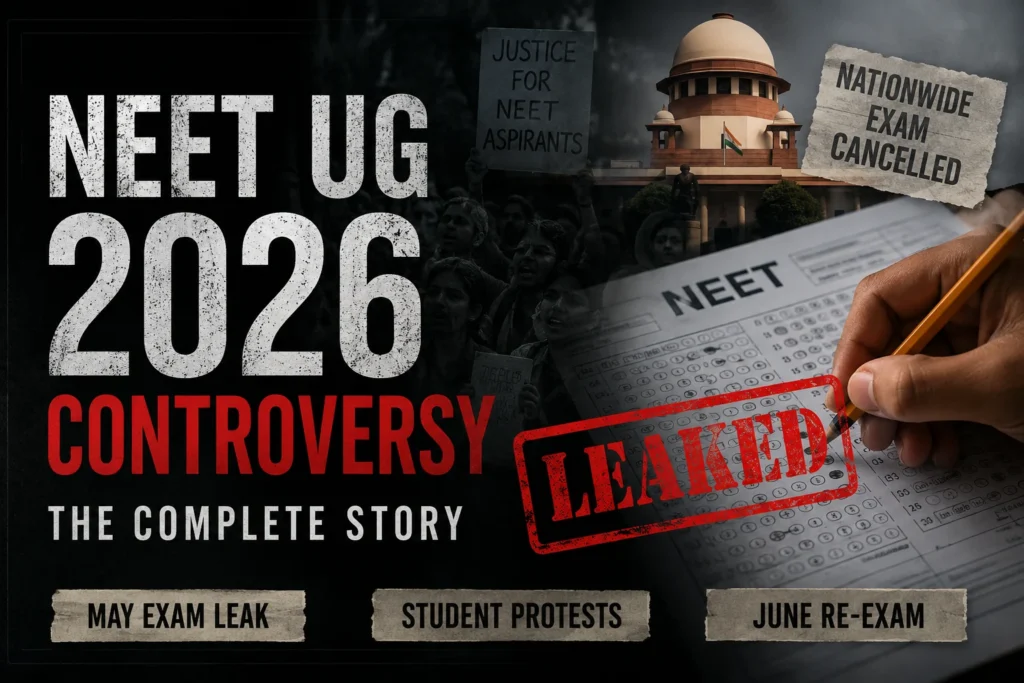
On May 12, 2026, the National Testing Agency officially announced the cancellation of the May 3 examination, scheduling a nationwide re-test for June 21, 2026. This decision was driven by several critical factors:
- Source-Level Contamination: The arrests of empanelled translators and experts like Havaldar and Mandhare proved that the compromise occurred before the papers were printed and distributed. Because these individuals had early access to the national master copies, it was impossible to isolate the leak to specific regions, compromising the entire national merit list.
- Constitutional Vulnerability: Legal advisors warned that maintaining a compromised selection list would face immediate challenges in the Supreme Court. Proceeding with counseling based on the May 3 scores would have invited a wave of litigation under Article 14 (Right to Equality), risking prolonged delays to the entire academic cycle.
- Public and Political Pressure: Growing street protests, continuous media coverage, and demands for accountability from opposition parties and student unions made the validation of the May 3 exam politically untenable.
The cancellation aimed to restore transparency and fairness, but it also placed an immediate burden on over 22 lakh candidates who had to prepare for a second high-stakes exam in just 37 days.
The Human Toll: Trauma, Financial Despair, and the Tragedy of Academic Uncertainty
The administrative failure and subsequent cancellation had a devastating impact on students across the country. For many, the preparation cycle for NEET UG involves years of rigorous study and significant personal sacrifice. The sudden announcement of a re-exam forced candidates to rebuild their routines under intense pressure.
The human toll of this uncertainty was tragic:
- Student Suicides: At least 14 student suicides were reported across the country in the weeks following the cancellation.
- The Hisar Tragedy: On the morning of the re-exam, a 19-year-old aspirant from Hisar, Haryana, died by suicide. This was her third attempt at the exam; her second attempt on May 3 was cancelled due to the leak. Suffering from extreme stress, she consumed pesticide just hours before the test was scheduled to begin.
- Southern State Tragedies: Similar suicides were reported in Tamil Nadu’s Dharmapuri and Krishnagiri districts, highlighting the severe mental health impact of the prolonged crisis.
For economically vulnerable families, the re-exam also imposed a heavy financial burden. Many parents had emptied savings accounts or taken out loans to fund coaching classes, hostel stays, and travel expenses. The cancellation forced them to bear these costs a second time, turning an academic pursuit into a severe financial strain.
The Rise of Satirical Rebellion: Abhijeet Dipke and the Genesis of the Cockroach Janta Party

In the wake of the scandal, a unique protest movement emerged, blending youth frustration with political satire. The “Cockroach Janta Party” (CJP) was founded on May 16, 2026, by Abhijeet Dipke, a 30-year-old public relations professional and political communications strategist who had previously worked with the Aam Aadmi Party.
The movement was sparked by remarks made on May 15 by a Supreme Court bench led by Chief Justice Surya Kant. During a hearing, Kant had reportedly compared politically active, unemployed youth, social media critics, and activists to “cockroaches” and “parasites of society”. Although Kant later clarified that his comments were aimed at individuals practicing with fake degrees, the “cockroach” label stuck with the youth.
Dipke reclaimed the slur, launching the Cockroach Janta Party to channel youth frustration over paper leaks, unemployment, and systemic corruption. Within a week, the CJP’s Instagram account gained over 21 million followers, and over one million users registered on its official website.
Table 3: Comparative Analysis of the CJP’s Satirical and Policy Framework
The CJP’s platform merged satirical elements with serious demands for judicial, electoral, and educational reform.
Operational Element | Satirical Framing | Policy Reform Demanded | Practical Protest Tactics |
Institutional Accountability | Reclaiming the slur “Cockroach” to signify resilience under pressure. | Immediate resignation of Education Minister Dharmendra Pradhan. | Banging of thalis (steel plates) and spoons at Jantar Mantar. |
Systemic Exam Reform | Operating “wherever the Wi-Fi works,” mocking bureaucratic overhead. | Complete transition of NEET UG to secure digital testing. | Diaper donation drive (“Diaper A Day Keeps Leaks Away”) targeting the Ministry of Education. |
Social Justice | Membership open to the “politically frustrated” and “financially confused”. | ₹1 Crore financial compensation for families of students who died by suicide. | Overnight sit-ins; candle-light vigils for deceased students. |
Electoral/Judicial Ethics | Rejecting standard corporate-backed party models. | Banning Rajya Sabha seats for retired CJIs and enforcing strict anti-defection laws. | Hosting open-air youth assemblies, skits, and musical performances. |
To give the movement structure, the CJP appointed official spokespersons: investigative journalist Saurav Das as chief spokesperson, filmmaker and researcher Vijeta Dahiya, and former McKinsey consultant Ashutosh Ranka. On June 6, 2026, Dipke returned from the United States to lead a massive protest at New Delhi’s Jantar Mantar. Protesters wearing cockroach masks and carrying study guides turned the site into a continuous sit-in, keeping the issue in the national spotlight.
The Jantar Mantar Occupation: Community, Resistance, and Sonam Wangchuk’s Fast Ultimatum
The CJP’s campaign at Jantar Mantar grew from a modest gathering into a sustained protest movement. Demonstrators occupied the site overnight, defying police orders to vacate after the 5:00 PM curfew. Protesters set up community kitchens and distributed water, turning the venue into a symbol of student resistance.
The movement gained broader support when prominent climate activist and education reformer Sonam Wangchuk joined the protests. Speaking at a rally on June 14, 2026, Wangchuk expressed solidarity with the students, calling himself an “honorary cockroach” and urging the government to address the concerns of young people instead of suppressing dissent.
Wangchuk and Dipke issued a joint one-week ultimatum to the Education Minister: resign or face a larger, hunger-strike-backed mobilization. Wangchuk announced that if Pradhan did not step down, he would initiate a fast on June 27, 2026. This involvement elevated the student protest into a broader discussion on ethical governance and educational accountability.
However, the movement also faced pushback. Pro-government social media pages with names like “Hit the Cockroaches” emerged to mock the protesters, and some questioned the funding sources for the food and amenities provided at the site. Dipke also faced physical hostility, being slapped during a mobilization in Jaipur. Despite these challenges, the protesters remained at Jantar Mantar, maintaining their demands as the re-exam approached.
The Integrity Debate: Evaluating the NTA’s Track Record Against Historical Scandals
The 2026 crisis renewed a broader debate about the credibility of India’s centralized testing infrastructure, with commentators comparing it to previous examination scandals.
Table 4: Chronological Analysis of Key NTA Examination Compromises
The table below outlines the major logistical and security challenges faced by the NTA between 2021 and 2026.
Year | Examination | Nature of Reported Irregularity | Official Action Taken | Long-Term Systemic Impact |
2021 | Affinity Education Case | Remote hacking of exam computers from a center in Sonipat. | CBI raids at 20 locations; FIRs registered against private operators. | Exposed vulnerabilities in decentralized digital centers. |
2022 | UGC-NET / CUET | Isolated cheating claims; major logistical chaos and technical glitches during CUET’s debut. | Official denials by NTA; rescheduling of affected exam slots. | Highlighted the strain of managing massive student volumes. |
2024 | NEET UG Scandal | Trunks photographed in a strong room in Hazaribagh; questions leaked 24 hours prior to exam. | Limited retest for 1,563 candidates; 5 CBI chargesheets filed against 45 accused. | Severely damaged public confidence in the security of physical question storage. |
2024 | UGC-NET | Questions leaked and appeared on the dark web. | Complete cancellation of the exam a day after it was held. | Prompted the notification of the Public Examinations Act, 2024. |
2025 | JEE Main | 12 questions withdrawn due to errors in the final answer key. | Technical corrections applied; results recalculated. | Parliamentary committees expressed concern over NTA’s quality controls. |
2026 | NEET UG Crisis | Leak of Physics, Chemistry, and Biology papers through NTA’s empanelled translators. | Nationwide cancellation of the May 3 exam; full re-test held on June 21. | Forced a commitment to transition NEET UG to a digital format by 2027. |
This history of recurring issues suggested that the NTA was struggling to secure paper-and-pencil exams at this scale. Critics pointed out that despite executive promises and judicial warnings, the agency had failed to build a secure command chain, making structural reforms urgent.
The Constitutional Challenge: Dr. Mangala Kohli’s Petition Against Blanket Retests
While protests continued, the policy decision to cancel the exam was challenged in the Supreme Court. Dr. Mangala Kohli, a former Assistant Director General of Health Services (ADGHS) and senior medical administrator, filed a Public Interest Litigation (PIL) under Article 32 of the Constitution.
Dr. Kohli’s petition argued that a blanket, nationwide cancellation disproportionately penalized the vast majority of genuine candidates who had no connection to the leak. The petition contended that the CBI’s findings pointed to a “localized operational compromise through specific organized networks” in Latur, Pune, and Jaipur, rather than systemic, nationwide contamination. Forcing 22 lakh students to retake the exam was characterized as arbitrary, excessive, and a violation of candidate rights under Articles 14, 19(1)(g), and 21 of the Constitution.
The petition also called for structural reforms:
- Encrypted Digital Delivery: Securing the question paper chain.
- Biometric and AI-Assisted Monitoring: Preventing impersonation at all centers.
- Computer-Based Testing: Phasing out physical OMR logistics entirely.
- Independent Expert Committee: Conducting an audit of the NTA’s institutional shortcomings.
The Supreme Court, bench led by Chief Justice Surya Kant and Justice V. Mohana, declined to grant an immediate stay on the June 21 re-test, noting that interrupting the schedule at a late stage would cause further disruption. The court transferred the petition to a bench headed by Justice P.S. Narasimha, which was already hearing other NEET-related cases, deferring the next hearing to July 13, 2026. This decision allowed the re-examination to proceed while keeping the constitutional questions on proportionality open for future review.
Preparing for the Re-Exam: Team Bharat’s Logistical Mobilization and the Telegram Ban

To organize a national re-examination within a 37-day window, the government implemented a strict security framework known as the “Team Bharat” approach. This mobilization involved multiple central ministries, state governments, and paramilitary forces.
Table 5: Key Logistics and Security Statistics of the June 21 Re-Exam
The scale of the mobilization for the June 21 re-test is highlighted by the following data.
Logistical / Security Parameter | Statistical Measure | Systemic Purpose |
Total Registered Candidates | 22,79,743 | Eligible to sit for the re-test without extra fees. |
Total Examination Centers | 5,440 (India) / 14 (Overseas) | Standardized testing venues. |
CCTV Surveillance Feeds | 1,38,560 | Live monitoring linked to central control rooms. |
Active Observers deployed | 6,700 On-ground / 100+ Virtual | Real-time monitoring and compliance checks. |
Frisking & Biometric Personnel | 38,795 Frisking / 48,448 Biometric | Aadhaar-based face and fingerprint verification. |
Signal Jammers deployed | 51,311 | Blocking electronic communications during the exam. |
The logistics of the re-exam required a massive security effort. The Indian Air Force (IAF) was enlisted to transport the new question paper sets from secure printing presses directly to state hubs. Paramilitary forces, local police, and the Department of Posts managed the secure transfer of papers to local strong rooms under police escort.
A key part of this strategy was the temporary restriction on Telegram. Acting on NTA recommendations, MeitY announced a ban on the messaging platform in India from June 16 to June 22 under Section 69A of the IT Act, while also directing the app to disable its message-editing feature.
NTA DG Abhishek Singh explained that the ban aimed to stop scammers from using edited chats to create a “fake perception of a leak”. By cutting off this primary communication channel, the government hoped to reduce candidate anxiety and protect the integrity of the re-test.
The June 21, 2026 Re-Test: Unprecedented Surveillance and On-Ground Realities
On Sunday, June 21, 2026, the NEET UG re-examination was conducted under intense security. The NTA introduced new safeguards, including real-time biometric verification and strict center-level protocols.
Biometric Exception Protocol
To prevent delays, the NTA implemented a biometric exception protocol. If a candidate’s fingerprint or facial verification failed due to technical issues, poor scan quality, or server connectivity problems, they were not denied entry. Instead, they were permitted to sign a manual undertaking at the gate and undergo direct verification using valid identity documents, ensuring a smooth entry process.
Special Arrangements for Vulnerable Candidates
The NTA made special arrangements to support over 10,000 candidates registered under the Persons with Disabilities (PwD) category. Additionally, special accommodations were arranged for 81 candidates with serious medical conditions, including a student undergoing chemotherapy and another recovering from a major road accident, ensuring they could take the exam safely.
The day also saw unique events. In New Delhi, Prime Minister Narendra Modi chose to wait at the airport after arriving from Kolkata to ensure his official convoy did not create traffic restrictions that could disrupt candidates traveling to their centers.
However, the strict enforcement of rules also led to friction. At several centers, female candidates wearing traditional articles of faith, such as the burqa, were stopped at the gates for security checks, sparking brief disputes before being verified in private.
The Candidate Verdict: Difficulty Curve, Subject-Wise Reactions, and Technical Challenges
Initial feedback from the June 21 re-exam indicated that the paper was significantly more challenging than the cancelled May 3 test. This shift in difficulty was widely discussed among coaching experts and students.
Total NEET Score = (Correct Answers × 4) − (Incorrect Answers × 1)
Candidates used the standard marking scheme to estimate their performance, but many noted that the tougher paper would likely impact their scores.
Subject-Wise Analysis of the Re-test
- Physics: Tough and Lengthy: Physics was widely considered the most difficult and time-consuming section. It was dominated by complex numerical questions and conceptual problems that required significant calculation time, leaving many students rushed.
- Chemistry: Moderate but Analytical: The Chemistry section was seen as moderate in difficulty. It required precise application of physical chemistry concepts and detailed calculations, but was considered manageable for well-prepared students.
- Biology: High NCERT Alignment: Biology (Botany and Zoology) was considered the most straightforward section. Most questions were directly based on NCERT textbooks, though the inclusion of lengthy statement-based and assertion-reasoning questions made it time-consuming.
The increased difficulty of the paper was expected to result in a lower, more realistic cut-off compared to previous years. While some candidates welcomed the opportunity to improve their scores, others felt the prolonged preparation and increased difficulty had added to their mental pressure and academic uncertainty.
Digital Warfare: Fact-Checking Misinformation and the Telegram Fraud Rings
Despite the temporary ban on Telegram, the NTA had to actively combat misinformation campaigns on the day of the re-exam. Within hours of the test concluding, a video emerged on social media claiming that the June 21 question paper had been leaked on Telegram the previous evening.
The NTA and the PIB Fact Check unit quickly investigated the claims and declared the video fake. The NTA pointed out that the booklet shown in the video did not contain the mandatory OMR answer sheet, proving it was fabricated to create confusion. NTA DG Abhishek Singh emphasized that no individual or platform had access to the papers before the exam started at 2:00 PM on June 21.
The investigation also led to practical actions. The cyber-crime cell of the Ahmedabad City Police arrested two individuals from Rajasthan who had operated Telegram channels promising leaked papers in exchange for money. Although no actual papers were found with them, their arrests highlighted how fraud rings sought to exploit student anxiety for financial gain.
Expert Consensus: Structural Reforms, the CBT Transition, and Post-Crisis Policy Outlook
The NEET UG 2026 crisis has led to a consensus among education experts, legal professionals, and policy analysts that India’s centralized testing systems require fundamental, structural reforms.
- Phasing Out Paper-Based Exams
Experts agree that traditional pen-and-paper, OMR-based exams are highly vulnerable to physical leaks. The physical handling of question papers during printing, transit, and storage creates too many potential points of compromise. Moving to a secure Computer-Based Test (CBT) model, similar to JEE Main, is seen as a necessary step to secure high-stakes national exams.
- Upgrading NTA’s Institutional Status
Many legal and policy experts have pointed out that the NTA’s status as a registered Society limits its authority and direct accountability. They argue that the NTA should be transformed into a more autonomous, professional, and accountable statutory body, similar to the Union Public Service Commission (UPSC). This upgrade would help the agency build a dedicated, permanent cadre of security and psychometric experts.
- Restructuring Large-Scale Exams
The intense competition for limited seats has created a highly stressful environment for students, fueling a lucrative market for cheating networks. To ease this pressure, the Radhakrishnan Committee has proposed exploring multi-session and multi-stage testing formats, distributing the logistical load and reducing the “do-or-die” pressure of a single exam afternoon.
Conclusion: Restoring the Social Contract and Rebuilding Student Trust
The NEET UG 2026 controversy represents a defining moment for educational policy and public administration in India. The journey from the compromised May exam to the heavily secured June re-test highlighted both the vulnerabilities of the centralized testing system and the government’s capacity for rapid mobilization during a crisis. While the “whole-of-government” effort successfully delivered a secure re-test on June 21, the systemic flaws that allowed the leak to occur remain a critical concern.
Restoring long-term public trust requires moving beyond emergency measures like temporary internet bans and military-backed transport. The transition to a Computer-Based Test (CBT) by 2027, the implementation of the Radhakrishnan Committee’s recommendations, and institutional reforms to strengthen the NTA’s operational independence are essential steps.
For millions of aspirants who dedicate years of their youth to these competitive exams, the integrity of the testing system is a matter of basic fairness. India’s ability to maintain a transparent, secure, and merit-based selection process will shape the future of its medical profession and the trust of its youth in the nation’s institutions.
Disclaimer: This article is published for informational purposes only and is based on publicly available information, official statements, and media reports. Ongoing investigations, legal proceedings, and government announcements may change over time. Readers should refer to official sources for the most up-to-date information.